NIDA Releases New Network Standards for the Education and Medical Industry in Shenzhen, and the Smart Classroom of Xi'an Jiaotong University Receives Authoritative Certification
Recently, Network Innovation and Development Alliance (NIDA) hosted the 3rd Network Innovation and Development Conference in Shenzhen, with the theme of "Crossing Industry Borders and Unleashing Innovation Momentum", attracting industry representatives from government departments, basic telecommunications enterprises, equipment manufacturers, universities, and scientific research institutions. Wu Hequan, an academician of the Chinese Academy of Engineering, pointed out in his speech at the conference that AI will move from algorithm innovation to systematic application in the whole society, and networks will move from "connecting people" to "connecting intelligence".
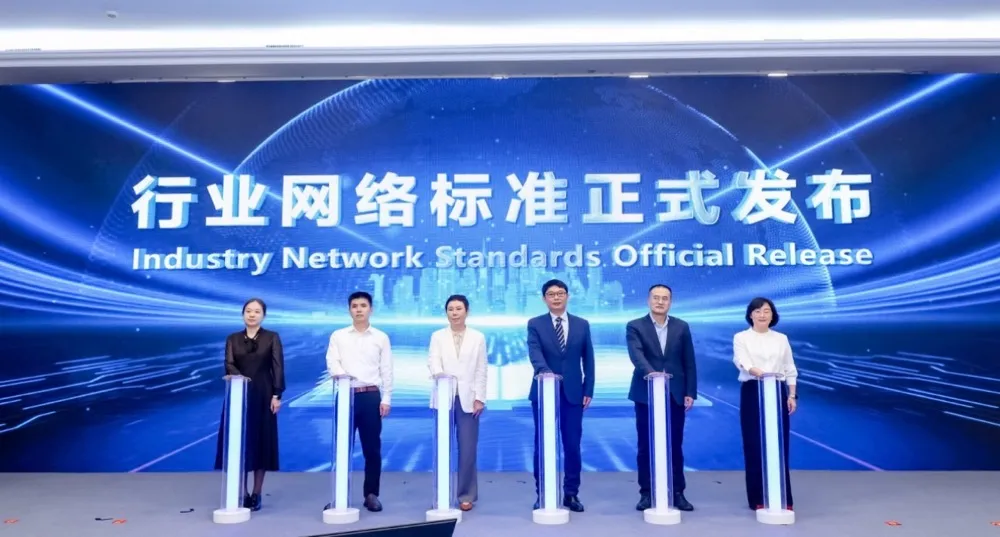
Official release of industry network standards:
Education and Healthcare Usher in New Network Standards
In recent years, NIDA has made great achievements in standards practice. Following the release of the world's first self-intelligent network construction standard for the education industry in July 2025, NIDA again released and interpreted new standards for campus network construction in the education and healthcare industries.
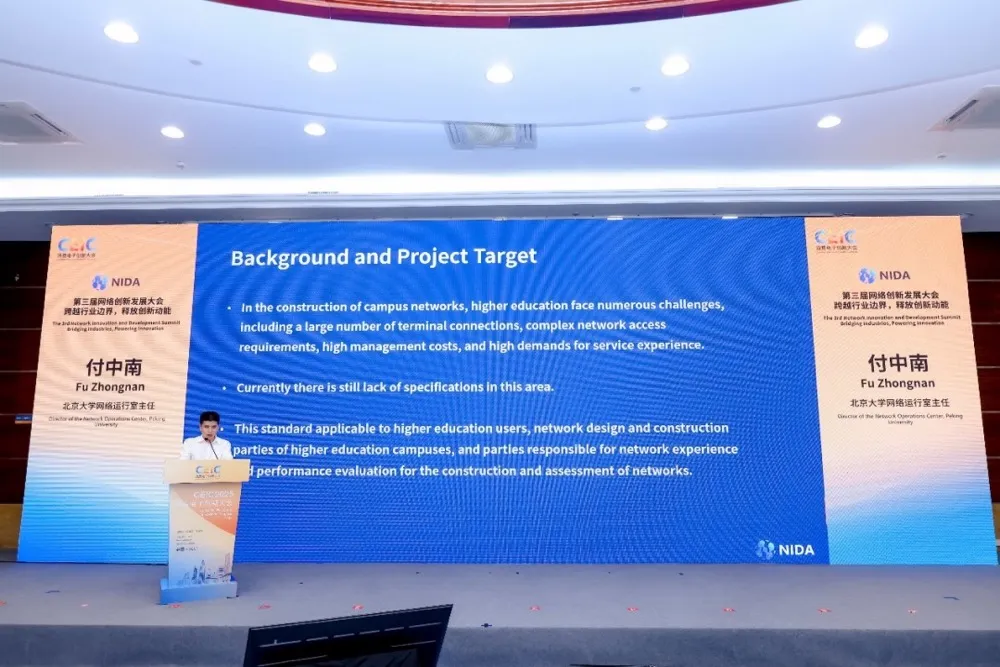
On campus network, the number of network devices and terminals is increasing, and the service requirements are becoming more and more complex. The teachers and students have higher and higher requirements on network service quality. Campus networks are facing the following challenges: The network coverage covers multiple dimensions, such as basic networks, network applications, network security, network O&M, and network energy saving. However, the network construction mode still relies on traditional experience verification and lacks a scientific network construction evaluation system. When high-quality teaching applications, such as HD conferencing, VR/AR, and access of a large number of terminals, the existing network architecture cannot meet fast-evolving service requirements or effectively improve O&M efficiency. The College Campus Network Evaluation Indicators and Test Methods released this time builds a standardized evaluation system for the education industry network construction for the first time. The quantitative indicators and scientific test methods provide authoritative technical guidance for campus network planning, construction, and O&M, and will effectively promote the intelligent upgrade of education informatization infrastructure.
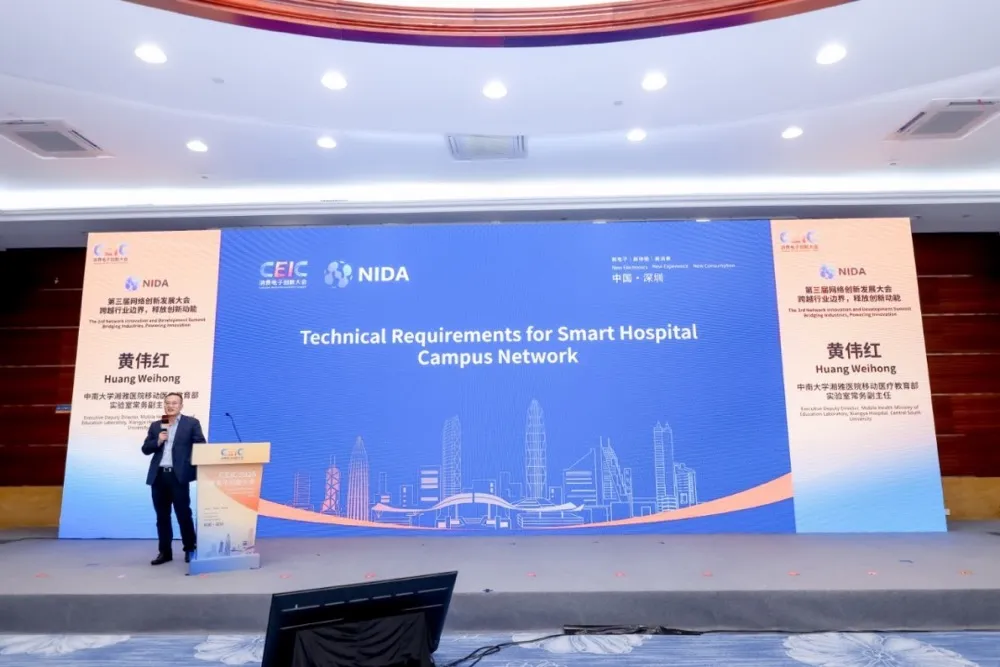
The healthcare industry's need for the network is comprehensive and systematic, much more than "faster." It requires the network to transform from a connection tool to a reliable, intelligent, and convergent medical service bearer platform. In the hospital, the network supports thousands of medical devices. (Monitors, Infusion Pumps, Ventilators, Vital Sign Sensors, etc.) Provides stable and low-power access, ultra-large bandwidth, deterministic low latency (in milliseconds), and reliability of over 99.999%. To meet the requirements of remote robotic surgery, real-time image transmission of mobile ultrasound/radiology equipment, data synchronization during emergency and first aid, and real-time retrieval and 3D reconstruction of high-definition medical images (such as pathology section, CT, and MRI). Non-contact monitoring of patients requires wireless networks to integrate sensing capabilities and evolve to synaesthesia-integrated networks. In addition, network capabilities need to be extended from in-hospital to out-of-hospital to stably support telemedicine, Internet hospital, and home monitoring scenarios, breaking geographical restrictions, and building a hospital-community-family integrated continuous medical service system. The Smart Hospital Campus Network Technical Requirements released this time analyzes the network requirements of various service scenarios of hospitals, proposes a network architecture that meets the requirements of future smart hospitals, specifies the network technical requirements that smart hospitals need to meet, and provides a clear implementation path for smart hospitals to build new networks.
Collaboration between industry and education: Xi'an Jiaotong University Awarded Industry
First Campus Network Assessment Certification
Driven by the College Campus Network Evaluation Indicators and Test Methods, many top universities have participated in the new standard construction process and collaborated to promote network technology innovation and standards implementation. DEKRA and Network Innovation and Development Alliance (NIDA) focus on the smart classroom network scenario of Xi'an Jiaotong University and conduct systematic evaluation from six core dimensions: all-domain security, energy-saving, high-speed network, defined experience, ubiquitous connectivity, and autonomous network. After strict tests and verification, Xi'an Jiaotong University's campus network performance not only surpassed the industry benchmark, but also won the industry's first campus network assessment certificate for its excellent performance. This milestone indicates that the university has established an industry model in smart classroom network planning, construction, and O&M, and provides replicable and popularized best practices for university network standardization.
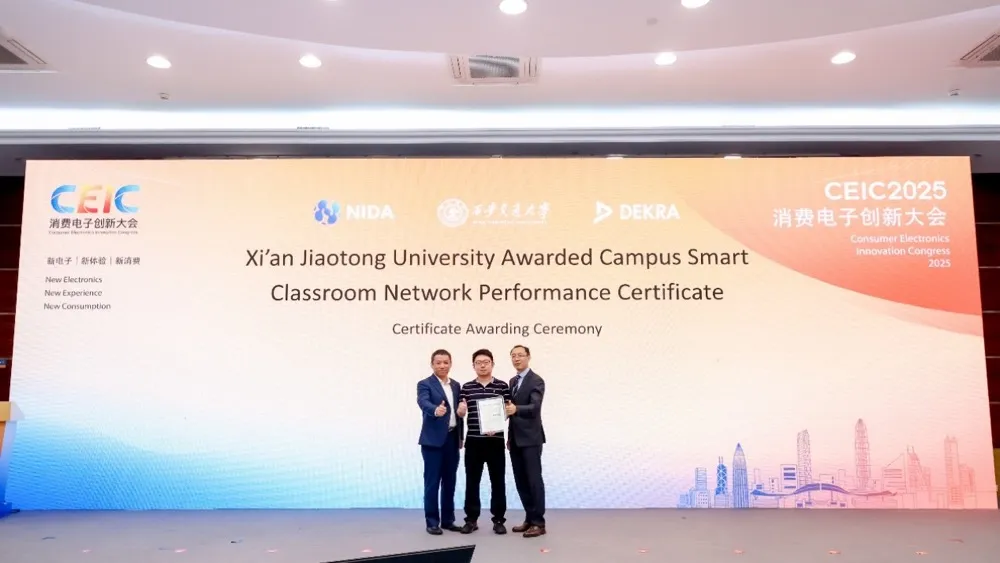
Zhang Zhe, head of the core network of the Innovation Harbor Campus of Xi'an Jiaotong University Network Information Center, said: "It is an honor to receive a certificate of authority from DEKRA and NIDA at this global innovation event. This is the acknowledgment of Xi'an Jiaotong University's informatization construction achievements, but also a kind of encouragement. "
Looking forward to the future, network evolution in the AI era is not only a technical issue, but also a system issue. NIDA calls on all parties in the industry to work together to find the "maximum common divisor" of network development and build an open and win-win ecosystem. With the release and implementation of network standards in the education and healthcare industries and the promotion of practical cases like Xi'an Jiaotong University, the next-generation network technologies will enable vertical industries and promote digital transformation and upgrade.