Empowering High-Quality Digital Economic Growth: Research Report on Smart Data Communication Network Evolution for IMT-2030 Officially Released
Shenzhen, China, October 22, 2026】 On October 22, at the Network Innovation and Development Conference 2026 (NIDC 2026) hosted by the Network Innovation and Development Alliance (NIDA), the landmark report Research Report on Smart Data Communication Network Evolution for IMT-2030 (hereinafter referred to as the Report) was officially released. The Report systematically elucidates the evolution path of smart data communication networks toward 2030. Centered on three key scenarios—6G, computing power networks, and agent networking—it proposes enabling technologies across six core dimensions: Ultra-Broadband, AI Native & Multi-Dimensional Sensing, Deterministic Experience, Lossless High-Throughput, Network Autonomy, and Security Resilience, providing a clear theoretical baseline and evolutionary roadmap for future network development and industrial implementation.
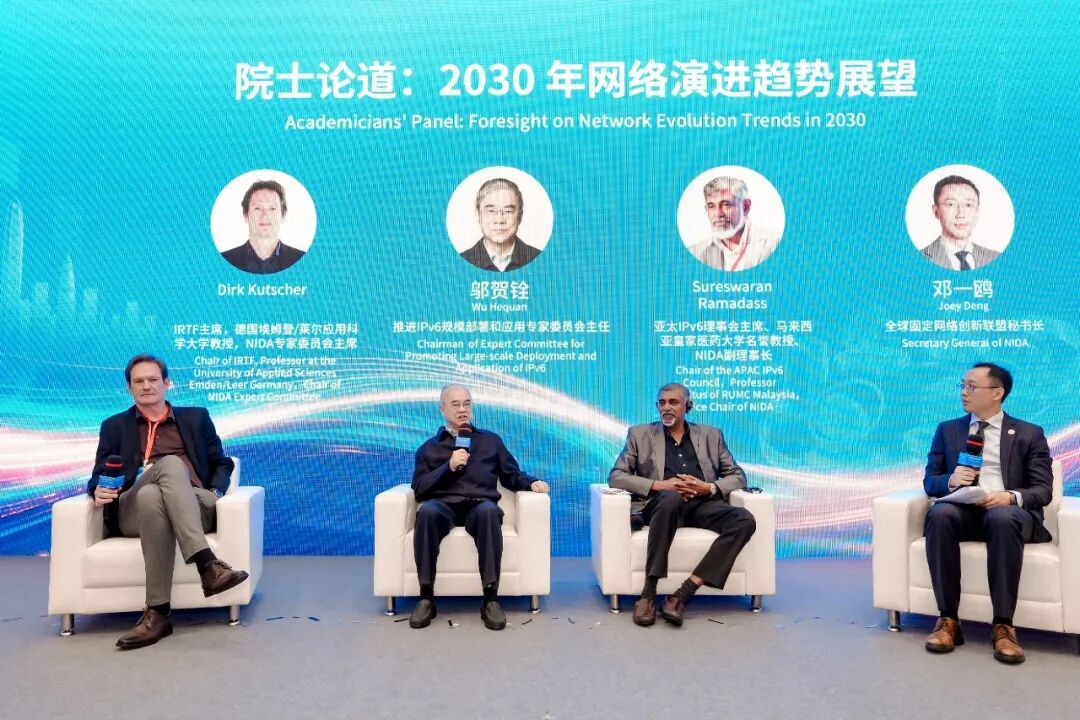
During the Academicians' Panel themed "Perspectives on Network Evolution Trends Toward 2030," Wu Hequan (Director of the Expert Committee for Promoting Large-Scale IPv6 Deployment and Application), Sureswaran Ramadass (Asia-Pacific IPv6 Chair), Dirk Kutscher (IRTF Chair), and Deng Yiou (NIDA Secretary-General) held a joint dialogue on stage. Grounded in the wave of AI transformations and network evolution trajectories, the experts discussed the main themes of network development in the intelligent era.
The experts highlighted that driven by the rapid advancement of 6G, large AI models, autonomous agents, and computing power, future networking scenarios will focus on three primary directions: 6G mobile bearer networks, computing power networks, and agent networking. Data communication networks are accelerating their transition into an intelligent digital foundation deeply integrating communication, sensing, computing, and intelligence. Networks must not only provide real-time, lossless, and ultra-reliable support for 6G ubiquitous connectivity, but also build a wide-area, lossless, elastic, and securely isolated interconnect system for large-scale compute scheduling. Furthermore, networks must leverage semantic addressing and deterministic channels to accommodate autonomous interactions and concurrent collaboration among AI agents.
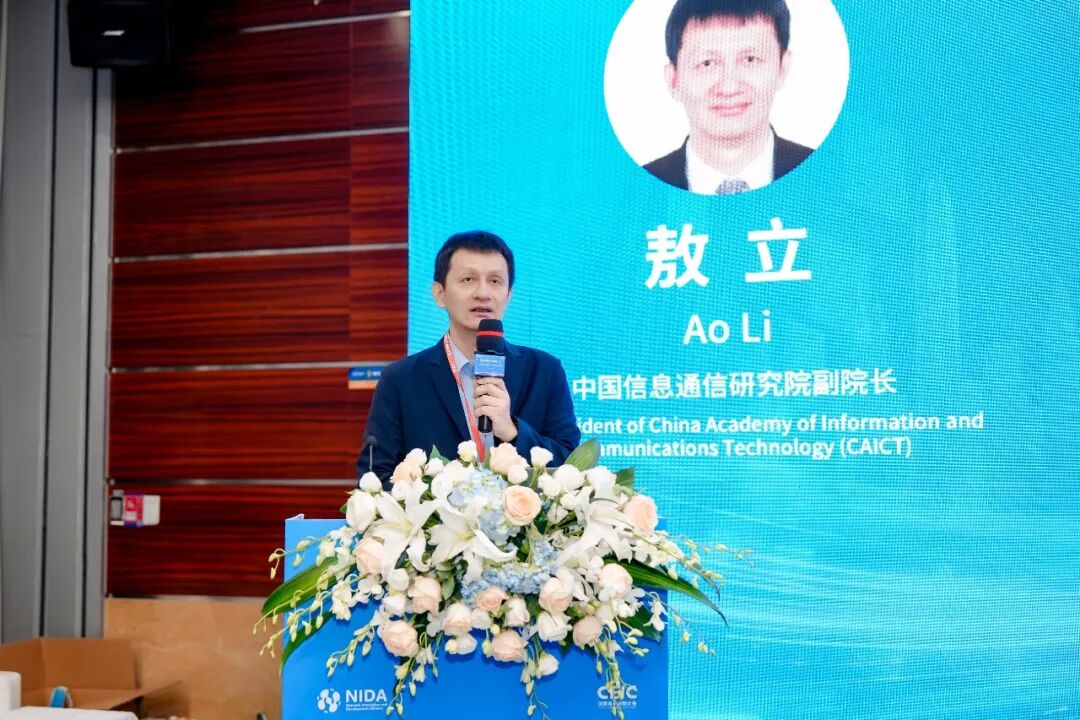
Ao Li, Vice President of the China Academy of Information and Communications Technology (CAICT), provided an in-depth interpretation of the Report. Ao Li stated that Smart Data Communication Network 2030 represents a next-generation IP network for the intelligent era—centered around network agents—to create an architecturally leading, technologically advanced, lossless intelligent, secure resilient, green efficient, and autonomous network platform supporting integrated high-quality services across computing, networking, and security. The Report outlines six core enabling technical pillars: Ultra-Broadband: IP networks utilize 800GE/1.6T ultra-broadband ports to construct non-blocking, massive-capacity forwarding planes, serving as an ultra-broadband connectivity foundation for integrated computing and networking; AI Native & Multi-Dimensional Sensing: Powered by the NetTrans network large model, the network achieves encrypted flow recognition for AI applications and multi-dimensional perception of experience degradation; Deterministic Experience: Hardware fast-forwarding mechanisms compress single-device forwarding latency, while FlexE source-routing overhead enables on-demand orchestration of elastic hard pipes; Lossless High-Throughput: Flow control granularity is lowered to individual tenants and single flows, reducing adaptive routing complexity to O(M*N) while coordinating with Congestion Notification Packets (CNP) for congestion control; Network Autonomy: Alarm correlation compression and root-cause localization are achieved, propelling autonomous networks from L4 to L4.5 and enabling cross-domain, cross-vendor coordination; Security Resilience: A full-domain quantum-secure network integrating the data, management, and control planes is constructed, driving endogenous intelligent security protection within network devices.
The official release ceremony of the Report was grandly held at the event, aiming to accelerate the maturation of Smart Data Communication Network 2030 through the alignment of standards, technology, and industry, thereby building a solid, lossless, and intelligent IP foundation for global digital economic growth.
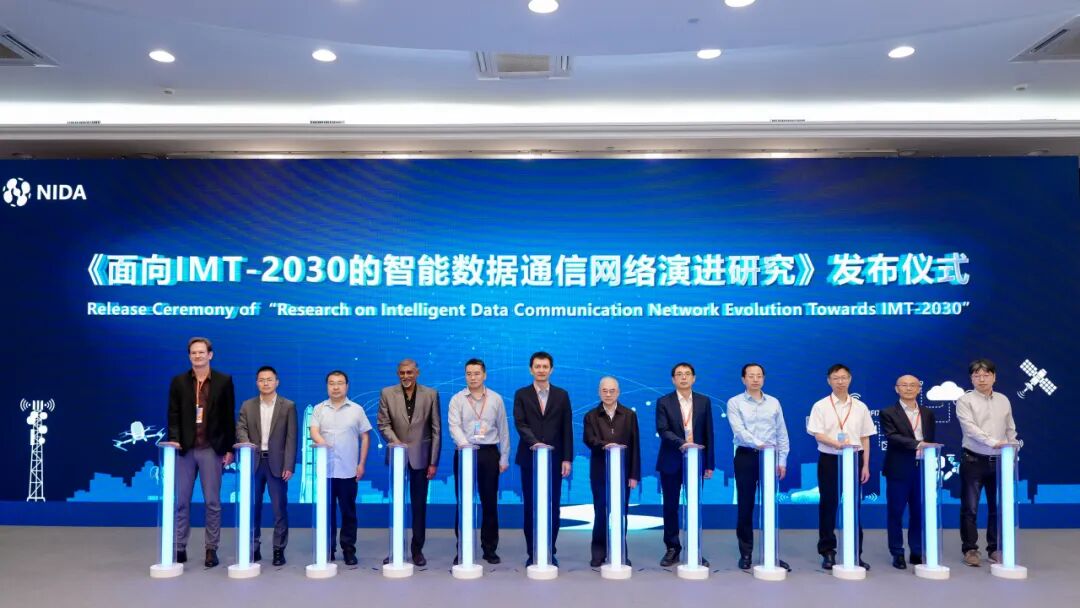
Release Ceremony of Research Report on Smart Data Communication Network Evolution for IMT-2030
Looking ahead, NIDA will continue joining forces with global industry partners to advance standardization and practical deployment around the key scenarios and technological directions defined in the Report, strengthening the smart data communication network foundation and empowering the high-quality development of the global digital economy.