Batch Release of Autonomous Networks Achievements: Transitioning from "Single-Point Definition" to "Systematic Closed-Loop"
[Shenzhen, China, October 22, 2026] During the Consumer Electronics Innovation Conference 2026 (CEIC 2026), at the Network Innovation and Development Conference hosted by the Network Innovation and Development Alliance (NIDA), five enterprise-oriented Autonomous Network achievements—including "Technical Requirements for Agent-Based Financial Data Center Network O&M Management" and "Technical Requirements for Agent-Based Campus Network L4 O&M 2.0"—were officially released. Government and corporate representatives from the Ministry of Science and Higher Education of the Republic of Kazakhstan, China University of Mining and Technology, Astana IT University, Beijing Wodong Tianjun Information Technology Co., Ltd., NIDA, and Huawei Technologies Co., Ltd. participated in the release ceremony. The deliverables encompass target architecture definitions for high-level enterprise network autonomy, as well as construction requirements and evaluation standards for agent-based O&M across financial data centers and campus networks. Joint efforts from all industry stakeholders have forged a high-quality evolution path for enterprise networks toward high-level autonomy, marking the transition of high-level autonomous networks from "single-point definition" to a "systematic closed-loop."
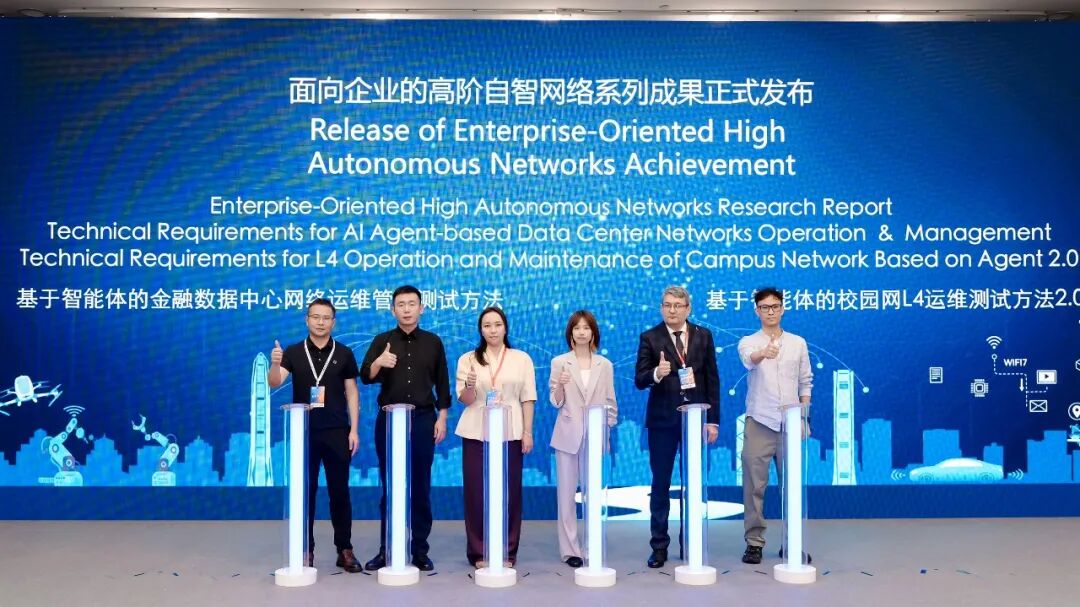
Release Ceremony of the Autonomous Network Series Achievements
Currently, autonomous networks are at a critical window of transition from proof-of-concept to large-scale deployment. For high-level autonomy to truly land in domain scenarios such as finance and education, it requires not only directional guidance, but also actionable technical requirements and verifiable testing methodologies. NIDA's batch release of achievements serves as a systematic response to this industry demand.
In the financial data center scenario, "Technical Requirements for Agent-Based Financial Data Center Network O&M Management" and "Test Methods for Agent-Based Financial Data Center Network O&M Management" were released as a paired set, filling the standardization gap for agent-based network O&M in ultra-reliable financial environments. Financial data centers place near-stringent demands on fault resolution determinism and business continuity, where functional descriptions alone are insufficient to drive industrial implementation. This combination of "technical requirements + test methods" transforms agent capabilities across high-value O&M scenarios—such as fault diagnosis, autonomous remediation, and change management—from high-level principles into measurable and verifiable engineering specifications.
The releases in the campus network scenario similarly demonstrate a clear iterative progression. "Technical Requirements for Agent-Based Campus Network L4 O&M 2.0" upgrades the 1.0 version published in 2025, with "Test Methods for Agent-Based Campus Network L4 O&M 2.0" updated concurrently. Centered on network digital twins, network large models, and specialized algorithmic small models as key enabling technologies, this series of standards defines the target architecture for campus network L4 (Autonomous Networks Level 4) O&M, along with evaluation workflows and scoring rules for agents in high-value scenarios.
Notably, this standards framework has entered the real-world validation phase: based on the campus network L4 O&M test methods, NIDA has conducted live-network evaluations across several universities, including Xi'an Jiaotong University, Southeast University, and China University of Mining and Technology. Moving from "requirements" to "testing" and ultimately to "live-network validation," campus network L4 autonomy is forming a replicable, standardized deployment path.
Taking a comprehensive view of the five achievements released in this batch, a clear logic threads through them: research reports address "where to go," technical requirements answer "what to build," and test methods determine "how to verify compliance." Interlocking with one another, the three elements propel autonomous networking from a visionary concept into an engineered, measurable implementation phase. The standardization progress in vertical sectors like finance, education, and enterprise will ultimately dictate whether high-level network autonomy successfully transitions from "network capability" into "business experience."