InnovateAsia26 Catalyst C26.5.1010: Autonomous IP Network and Green Energy-Saving Solution for University Campuses



University campus networks generally face two independent pain points: a lack of pre-event full-stack simulation and verification methods targeting internal server rooms for major teaching activities, and frequent access-side faults during classroom lectures and practical training where manual intervention easily interrupts instruction. At the same time, schools face a growing demand for energy conservation and emission reduction.
The uniqueness of this solution lies in reusing the CSI (Channel State Information) wireless sensing foundation and integrating iFlow full-stack simulation, fault self-closed-looping, and two other autonomous networking capabilities. A single sensing foundation simultaneously supports pre-event major guarantee and in-class fault auto-healing. Furthermore, it dynamically manages the energy consumption of electrical and network equipment based on CSI-sensed personnel activity states, breaking down the boundaries between autonomous networking and smart building control.

New teaching services place higher standards on network determinism and reliability. Campus access terminals are large in scale, and traffic flows follow clear tidal changes aligned with class schedules, examinations, and large lectures. With limited professional O&M manpower, traditional reactive O&M models rely on teachers and students reporting issues to initiate handling; network hidden dangers cannot be discovered in advance, fault troubleshooting heavily relies on manual efforts, and resolution cycles are relatively long. In addition, pre-event guarantees for opening ceremonies, major exams, and other activities require massive human resource investments. Meanwhile, a large volume of network equipment remains running at full power during business troughs such as class breaks, nights, and holidays, making it difficult to balance business assurance with energy-saving control.
The campus network autonomous solution builds four core autonomous capabilities: hidden danger self-identification, fault self-closed-looping, major activity self-assurance, and energy consumption self-regulation. The solution continuously collects comprehensive access metrics from switches, APs, and terminals, capturing potential risks before users initiate complaints. Targeting typical access-side faults such as weak signal coverage, high wireless interference, and load imbalance, it automatically localizes and resolves issues to reduce manual workload. Relying on iFlow 2.0, it conducts pre-event simulation dialing tests for critical teaching scenarios such as large-scale computer-based exams and special lectures, performing full-stack verification of authentication, DHCP, DNS, and page access to proactively mitigate network risks. By combining time, online terminal counts, and business load linkage strategies, it dynamically adjusts AP transmission power and manages device sleep modes. Concurrently, leveraging CSI technology linked with building management systems, it automates the turning on and off of lighting and air conditioning equipment to achieve automated energy consumption regulation.

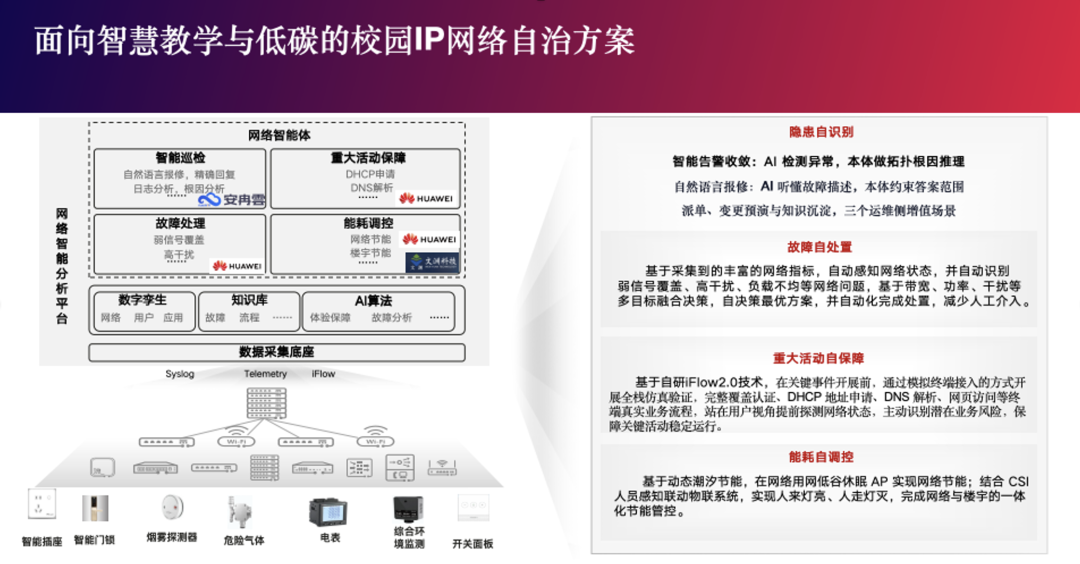
This project adopts a CSI wireless sensing foundation, integrating iFlow full-stack simulation, fault self-closed-looping, and two other autonomous networking capabilities. A single sensing foundation simultaneously supports pre-event major guarantees, in-class fault auto-healing, and area-wide low-carbon management, breaking down the barriers between data communication autonomy and smart building control.

AI Inspection Assists in Automatic Identification of Hidden Dangers
Alarm convergence merges dozens of derived alarms into 1 root-cause alarm, expected to improve efficiency by over 70%.
Automated root-cause localization combined with automated disposition recommendation for O&M personnel is expected to improve efficiency by over 50%.
In terms of repair response time, natural language-based repair auto-parsing and auto-routing enable self-service resolution for common issues, dropping response times from the hour level to the minute level.
Network Fault Self-Disposal
80% of wireless faults are self-processed.
Wireless fault repair time drops from the hour level required for manual repair down to 5 minutes.
Pre-Event Simulation Verification for Major Activities
Major faults achieve a 100% identification rate.
Fault handling duration is reduced by 76%.
Campus Energy Conservation
Air conditioning system energy savings: 8%.
Lighting system energy savings: 16%.
Network equipment energy savings: 30%.