NIDA Hosts Side Meeting at IETF 125 : Data Communication Network Evolution Scenarios
[Shenzhen, China, March 16, 2026] During the IETF meeting, the Network Innovation and Development Alliance (NIDA) hosted a side meeting under the theme "Data Communication Network Evolution Scenarios." The event brought over 100 attendees, including IETF experts, academic representatives, and industry specialists, to explore new scenarios and technologies in data communication networks in the era of artificial intelligence.
Liu Dong, Director of the National Engineering Center for Next Generation Internet, Inductee of the Internet Hall of Fame, noted that while "embodied" technologies are gradually maturing, the systemic coordination of "intelligence"—encompassing trustworthy data circulation, low-latency network interconnection, and security governance compliance—has become the biggest challenge to large-scale industrial adoption.
Addressing the challenges of transitioning from embodied intelligence to large-scale collective intelligence, Liu Dong highlighted three core pain points: insufficient supply of trustworthy data and knowledge, safety responsibility,and the lack of a standard system. He called on the industry to jointly build cross-industry and cross-regional "data communities," "network communities," and "rule communities." Liu emphasized that future networks, data, and rules will no longer be separate from artificial intelligence but will integrate under the support of IPv6 infrastructure, ushering in a new digital world of "AI Everywhere."
Deng Yiou, from the Network Innovation and Development Alliance (NIDA), first reviewed the evolution of the internet, noting that with the impetus of AI, the internet has entered the era of agent-based internet. Within the alliance's current research on four major scenarios—"Computing Connection," "Intelligence Connection," "Data Connection," and "Airspace Connection"—increasing applications and technical challenges are emerging across industries. For example, in telemedicine scenarios in hospitals, conflicts between local data storage and cloud-based computing resources, while the automatic interaction between intelligent agents introduces network burst and security issues. The Secretary-General also introduced NIDA's mission, positioning, and working group structure. By focus industry scenario needs, the alliance aims to guide the standardization of related new technologies at the IETF and pilot the latest technical standards in industry scenarios. Through a dual-wheel drive of scenarios and technologies, NIDA seeks to promote the development and prosperity of the data communication industry.
Carsten Rossenhoevel, Founder and CTO of EANTC, shared the latest developments in the commercial deployment of new technical standards. He highlighted SRv6, EVPN, network automation, and clock synchronization as key technical hot-spots for users. In transitioning from standards to commercial deployment, new technologies face numerous complex scenarios that require thorough validation testing and pilot deployment. As a globally renowned testing institution, EANTC has been committed to testing and validating the latest technological trends and scenarios in the communication industry, advocating for an open communication world built on open standards, minimal patents, trustworthy interoperability, and a healthy ecosystem.
Data serves as the core engine driving cross-industry innovation and fostering new scenarios, formats, and models in the digital economy. Data circulation is the key to unlocking the value of data. Liu Yisha, Technical Director of the National (Hangzhou) New-Type Internet Exchange Center, shared the architecture of data internet-related standards. The data internet is structured into four layers: the data enterprise layer, network infrastructure layer, platform infrastructure layer, and platform application layer. The exchange center resides in the network infrastructure layer, playing a critical role in global inter connectivity. She urged the industry to jointly study and develop a data internet standard system, providing a solid foundation for the secure and efficient circulation of data elements and the high-quality development of the digital economy.
During the discussion session, an expert from ZTE noted that AI will greatly promote the development of the internet but will also bring challenges in areas such as security. He emphasized that the integration of AI and networks should proceed gradually, with a focus on security, compliance, and trustworthiness. An expert from Futurewei pointed out that while the data internet is rapidly developing in China, its architecture and related technical definitions need further alignment with international standards to jointly advance the industry's growth.
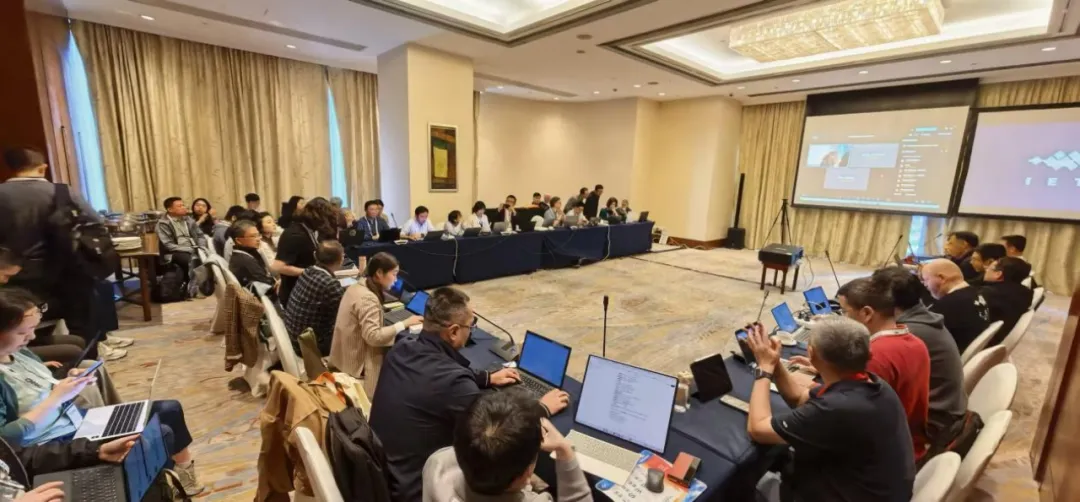
The successful hosting of this side meeting positively guided discussions on the evolution direction of IP networks and related technologies. In the future, as technologies like AI agents continue to develop, more new scenarios and technologies will emerge. NIDA, with its original intention of advancing the fixed network industry, remains committed to contributing the wisdom and strength of communication professionals to drive the high-quality development of the global digital economy.