Empowering AI in the Future | NIDA Launches 400G Per Lane MSA, Ushering in a New Era of Ultra-Broadband Ethernet
[Shenzhen, China, November 8, 2025] The Third NIDA Network Innovation and Development Conference 2025 was successfully held in Shenzhen, Guangdong. As an industry event in the global fixed network innovation field, the conference brought together representatives and technical experts from scientific research institutions, industry organizations, and leading enterprises to conduct in-depth exchanges on "Next Generation Network Development in the AI Era", anchoring the future network evolution path. Among them, an important outcome of the General Assembly is the formal establishment of "400G Per Lane MSA ( Multi-Source Agreement )". This MSA is initiated by China Mobile and brings together Alibaba, Tencent, Marvel, VIAVI, Tianfu Communications, Shengke, Optical Xun Technology, Optical Library Technology, Wanli Eye, Lixun, and ZTE. It is the core ecosystem partner of the Ethernet industry chain such as Germany Technologies and Huawei. We are committed to breaking bandwidth bottlenecks in the AI data center field and jointly promoting the development and large-scale application of next-generation ultra-broadband Ethernet technologies.
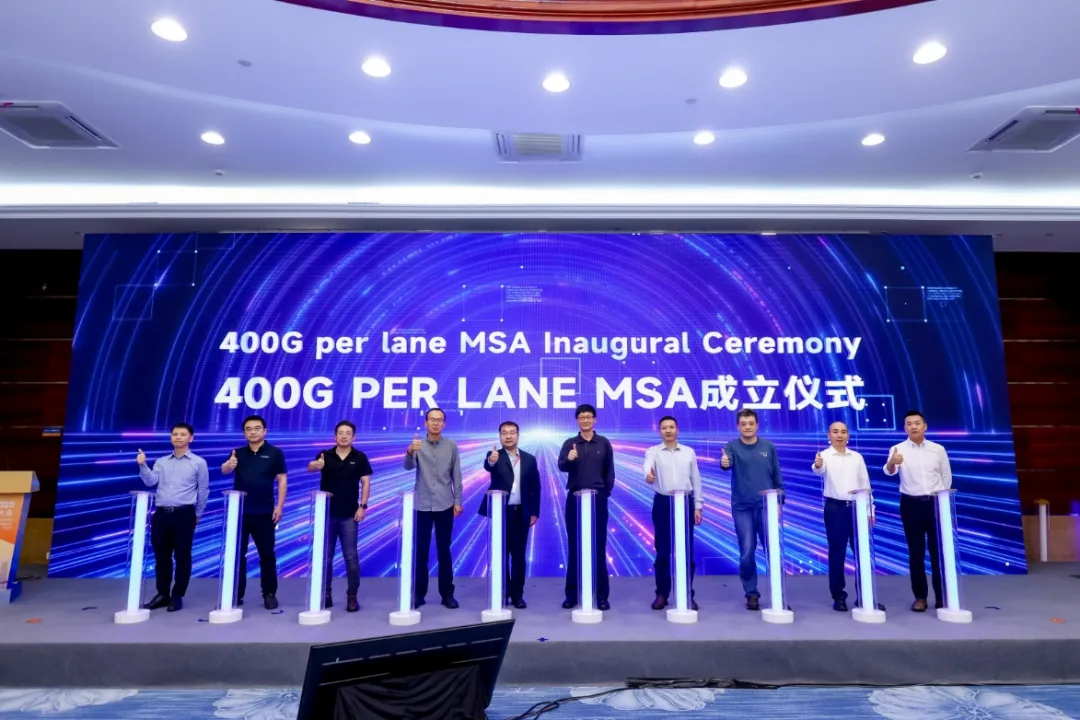
Cheng Weiqiang, deputy director of the Institute of Basic Network Technology of China Mobile Research Institute, explained the industry background and challenges of the establishment of the 400G Per Lane MSA, as well as the work objectives and cooperation initiatives of the 400G Per Lane MSA.
Core bottlenecks of AI clusters: High-Speed Interconnection Faces 400G Signal Challenges
Facing the computing challenges brought by large-scale models with hundreds of billions or even trillions of parameters, building super-large-scale AI clusters has become an industry consensus. In this process, the performance of ultra-high-speed Ethernet interconnection directly determines the efficiency and scale of cluster computing power output, and becomes the core basic technology to support the sustainable development of the AI industry. High-speed single-channel interconnection is the key technology.
Currently, technology development is facing a key generational turning point. For example, 800G Ethernet relies on the single-channel 112G interconnection technology ( 8×112G/lane ) , 1.6T Ethernet relies on the single-channel 224G interconnection technology (8×224G/lane )), while the future 3.2T Ethernet requires the single-channel 448G interconnection technology (8×448G/lane )). As the intelligent computing center has ever-increasing requirements on Ethernet rates, 1.6T Ethernet based on the single-channel 224G interconnection technology has been put into commercial use this year. The global industry is gradually focusing on the development of the next-generation single-channel 448G technology. To this end, NIDA launched the 400G per lane MSA working group to promote the maturity and standardization of the single-channel 448G interconnection technology.
However, doubling the rate also brings severe signal integrity challenges. Problems such as inter-channel crosstalk and insertion loss deteriorate exponentially, making system design more difficult.
This breakthrough requires a collaborative design framework that spans chips, packages, channels, and systems, and is restructured around the core proposition of "bandwidth-signal-to-noise ratio balance". This breakthrough will not only affect the success or failure of single-point technologies, but also define the competitive landscape and evolution path of next-generation AI infrastructure.
Breaking the Ecosystem Barriers : 400G/lane MSA Builds Unified Interfaces for Multi-vendor Interoperation
Data centers are rapidly evolving to 400G/lane or 800G/1.6T systems. However, interoperability between multi-vendor devices has become a key bottleneck for large-scale industry deployment. Solutions independently developed by vendors are prone to divergence in technology paths and form ecological barriers, which not only increases the cost and complexity of system integration, but also slows down the popularization of the overall technology.
Emphasizing openness and collaboration, 400G Per Lane MSA is committed to bringing together the world's leading forces in chip design, material science, and system architecture. Based on the advanced technology path, 400G Per Lane MSA has reached an industry consensus in fields such as optical-electrical-layer protocols and physical-layer interface standards. This lays a foundation for building an open and reliable 1.6T/3.2T high-speed Ethernet ecosystem based on single-channel 400G and provides an open and healthy industry ecosystem. and promote the adoption of the consensus by mainstream international standards organizations such as IEEE.
Build a new ecosystem based on open standards: Industry launches 400G/lane interoperability initiative
400G Per Lane MSA advocates leading global technology enterprises to develop open and unified interface standards to build a new ecosystem for next-generation data center interconnection. This initiative marks a new phase of industrial synergy development and will lay a solid foundation for 800G and higher-speed interconnection.
The MSA working group will focus on the core physical layer challenges of single-channel 400G high-speed interconnect technology, covering the following key areas:
No.1 Develop 400G/lane electrical interface standards, covering application scenarios such as chip-to-chip, chip-to-module, cable, and backplane.
No.2 Establish 400G/lane optical interface specifications and focus on optimizing short-distance optical connection performance.
No.3 Specify key technical specifications such as signal integrity, channel characteristics, and equalization requirements.
No.4 explores innovative modulation and coding schemes to achieve the best balance between performance and power consumption.
This initiative has received positive responses from enterprises in all sectors of the industry chain, including chip suppliers, optical component and optical module manufacturers, equipment vendors, and cloud service providers.
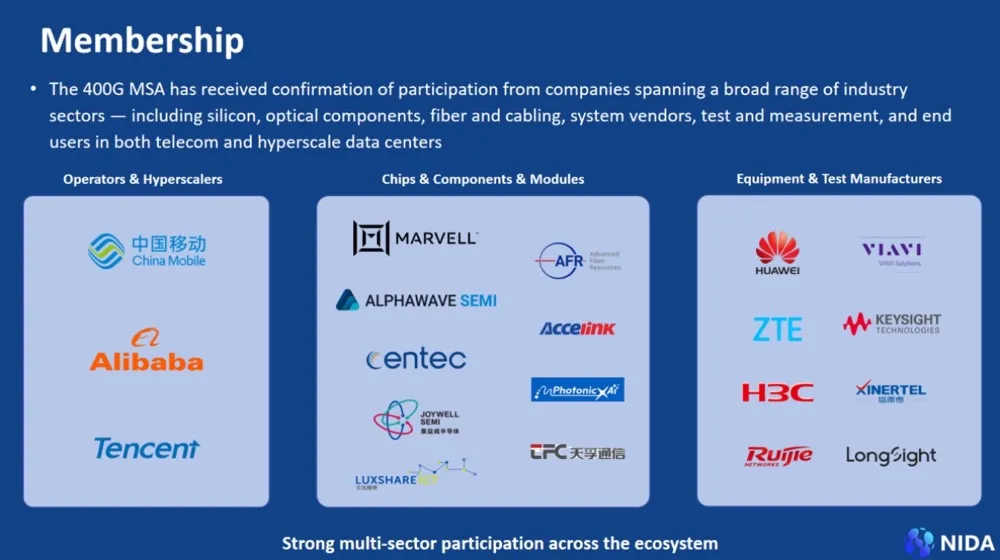
Based on the principles of openness and collaboration, MSA is committed to pooling global industry wisdom to promote the standard development process. To this end, the MSA will build an open collaboration platform that will provide key support to the industry such as interoperability testing, joint technology assessment, and expertise sharing.
NIDA 400G Per Lane MSA invites partners in the global industry chain to join in this open process and draw a blueprint for next-generation data interconnection.