400G per Lane MSA Releases White Paper on Next-Generation Ethernet PHY Technology
The 400G per Lane Multi-Source Agreement (MSA) hosted by NIDA released the industry's first comprehensive white paper on 400G per lane Ethernet physical layer (PHY) technologies. This industry-first analysis anticipates the emerging requirements for scaling AI clusters, where network bandwidth limitations increasingly constrain computing efficiency and cluster utilization.
As AI model parameters scale to trillions and AI clusters regularly exceed 100,000 accelerators, communication overhead can consume 30 to 60 percent of total training time. Switch radix saturation---constrained by packaging and thermal limits to approximately 128 ports---has made higher bandwidth per lane the primary scaling vector. The transition to 400G per lane Ethernet PHY technology represents the next frontier, demanding lane speeds exceeding 400Gb/s to achieve switch capacities beyond 400 Terabit per second.
Building upon a comprehensive assessment of the latest advancements in both optical technologies and electrical channels for 400G per lane signaling, the white paper evaluates modulation schemes and forward error correction (FEC) techniques, establishing a solid foundation for the development of interoperable Ethernet PHYs.
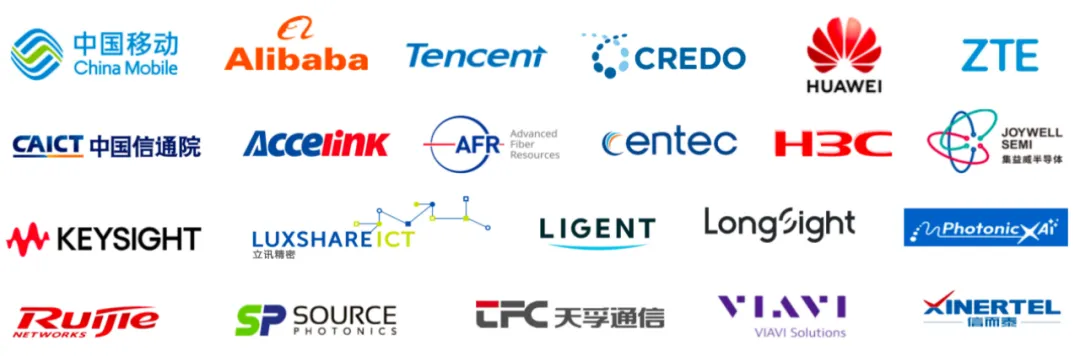
The technical study represents a collaborative effort bringing together over 20 member organizations to establish early technical consensus on emerging requirements. Contributors span across operators, hyperscalers, equipment vendors, component suppliers, and test/measurement vendors, including China Mobile, Alibaba, Tencent, Huawei, Credo, Keysight, ZTE, Accelink, AFR, CAICT, Centec, H3C, Joywell, Ligent, Longsight, Luxshare-ICT, PhotonicX AI, Ruijie, Source Photonics, TFC, Viavi Solutions and Xinertel. This early alignment helps reduce future interoperability risks and positions the industry to move cohesively as 400G per lane technology matures.
About 400G per Lane MSA and NIDA
The 400G per Lane Multi-Source Agreement (MSA) is dedicated to advancing 400G per lane Ethernet technologies and fostering multi-vendor interoperability. Founded in 2025, the MSA brings together leading operators, hyperscalers, equipment vendors, component suppliers, and test/measurement vendors to establish early technical direction and coordination for emerging 400G per lane technologies.
The Network Innovation and Development Alliance (NIDA) is an international, industry-based, non-profit social group formed voluntarily by industry organizations, universities, research institutes, companies, and enterprises from all over the world, focusing on promoting fixed network technology innovation and industrial upgrades.
To download the full whitepaper,please visit:
[https://www.nida-alliance.org/uploadfile/202604/41cb8edec7edd48.pdf].