NIDA & AP IPv6 Experts Share 2030 Network Evolution Roadmap for Vietnam Digital Economy
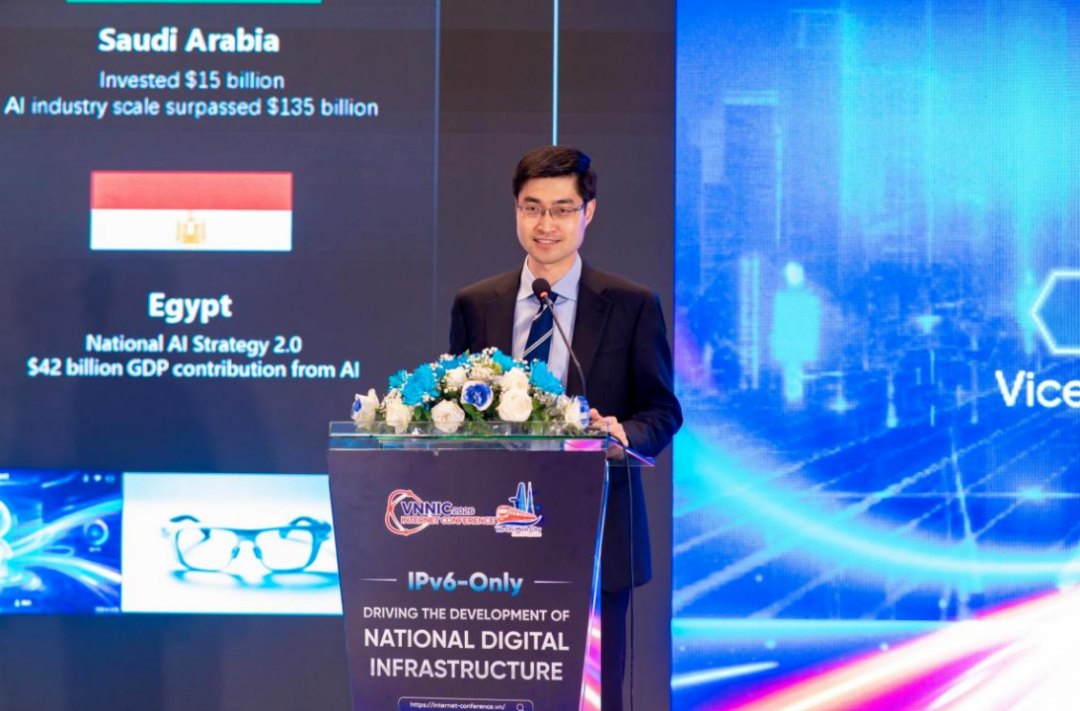
[Ho Chi Minh, Vietnam, 19 June 2026] The Vietnam Internet Conference 2026 was held in Ho Chi Minh City from June 16 to 19. The summit focused on how next-generation internet infrastructure supports emerging applications such as artificial intelligence (AI). Over 200 representatives attended the event, including officials from Vietnamese regulatory authorities, domestic telecom operators, universities, Southeast Asian ICT enterprises, and international standards organizations. During the main forum on June 19, Dr. LIU Shucheng, Director of the Industrial Development Department at the Network Innovation and Development Alliance (NIDA) and Vice Chairman of the APAC IPv6 Council, delivered a keynote speech. He shared insights into the network evolution roadmap toward 2030 and proposed a new network foundation characterized by high speed, high quality, and high security, providing actionable references for digital transformation in APAC.
Accelerated AI Deployment Drives Comprehensive Restructuring of Underlying Network Architecture
AI has been elevated to a national strategic priority for major global powers. China, the United States, and multiple European countries have introduced top-level AI development plans, while emerging markets such as Saudi Arabia, Indonesia, and Egypt have successively released dedicated national AI strategies and ramped up investments in the digital industry. Omdia predicts that AI will drive rapid revenue growth in the ICT sector. The AI boom is generating massive volumes of data, leading to increasingly stringent data security requirements across key industries. Traditional bearer networks must not only enhance bandwidth and service quality but also strengthen security protection capabilities. Furthermore, data center networks must achieve congestion-free scheduling and proactive security isolation.
According to Roland Berger, IPv6 Enhanced, leveraging four core capabilities—SRv6, network slicing, digital twin, and autonomous driving networks—can simultaneously expand network access scale, optimize service quality, and streamline operation and maintenance processes. It is projected that global technological innovations related to IPv6 Enhanced will generate $10 trillion in economic value by 2030.
In the realm of standardization, the ITU-T has published the Y.3188 standard to define network requirements for AI scenarios and has initiated the drafting of a 2030 technical report targeting the 6G and Agentic AI era. The WBBA, in collaboration with over 200 industry members, has put forward an end-to-end network architecture based on IPv6 Enhanced. This architecture encompasses metro & backbone networks, data center networks and campus/enterprise networks, integrating core technologies such as SRv6, 400/800GE, and Wi-Fi 7. NIDA and APAC IPv6 Council have established five standardization working groups focusing on network evolution, autonomous networks, campus networks, data center networks, and network security. These groups are developing comprehensive network construction standards centered on high speed, high quality, and high security.
Localized Solutions Tailored to Vietnam's Digital Infrastructure Upgrade
Based on Vietnam's current industrial landscape,
Dr. Liu proposed a series of actionable recommendations to comprehensively support local AI development. These include upgrading 400GE IPv6 Enhanced metro & backbone networks, promoting Wi-Fi 7 10Gbps campus/enterprise networks, deploying 800GE lossless computing data center networks, and scaling up direct fiber connections for FTTS base stations.
Addressing network security challenges in the AI era, the layered defense system of IPv6 Enhanced integrates an AI traffic detection engine. This enables real-time monitoring at the second level and rapid disposal of non-compliant information, fully aligning with network regulatory and compliance requirements across various countries.
With top-level IPv6 policy planning in China and France as representative case studies, the speech vividly demonstrated the driving value of high-speed intelligent networks for the digital economy, offering valuable insights for Vietnam and other Southeast Asian nations.
Deepening Regional Standardization Cooperation to Solidify the Foundation for 2030 Digital Development
In his concluding remarks, Dr. Liu emphasized that NIDA and APAC IPv6 Council are open and inclusive international standards organizations that have previously established partnerships with local standards bodies in countries such as Indonesia and Kazakhstan. Looking ahead, the Alliances are willing to deepening collaboration with local standards and industry organizations of Vietnam and other APAC countries to jointly develop localized network development guidelines, thereby helping Vietnam comprehensively enhance the competitiveness of digital infrastructure. The Alliance also welcomes more global partners to join forces in advancing the digital and intelligent transformation of society.