Hetao "1+6" International Organizations Weekly Insights | How Does the New Paradigm of Standards Organizations Flourish?
NIDA
2026-07-02 00:00:00
0
This article is the first in the Insight Series on the compiled edition of the Hetao "1+6" *International Organizations Weekly*.
01 The Past and Present Lives of Hetao
If one merely understands the Hetao "1+6" as "six international organizations inside a cluster area," they are underestimating its true weight; however, without first explaining what "Hetao" is, it would also be difficult to understand why this organizational ecosystem has grown here.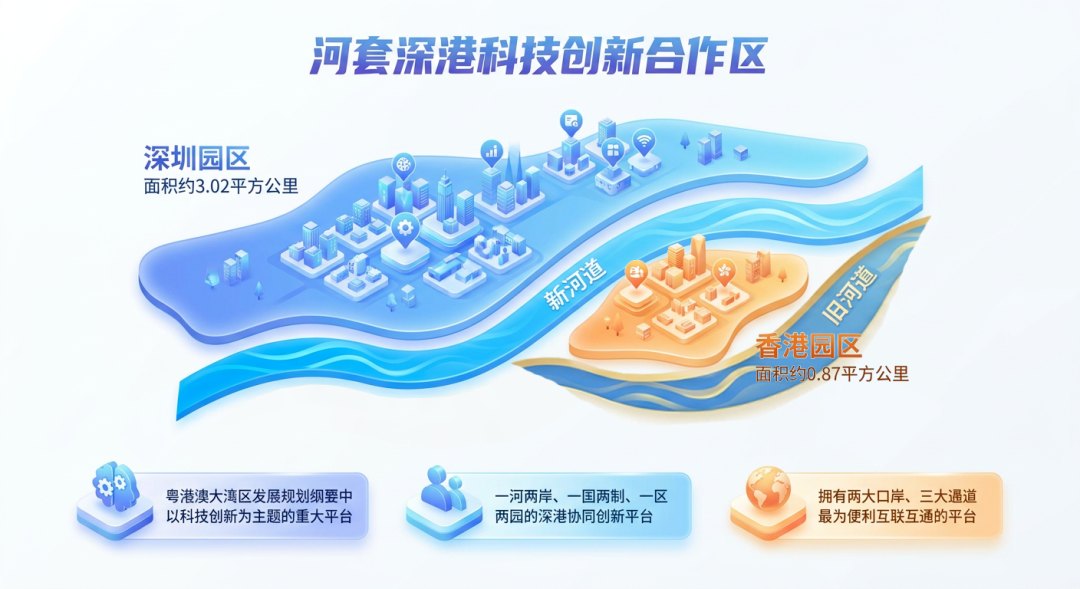 The Hetao Shenzhen-Hong Kong Science and Technology Innovation Cooperation Zone is located at the border between Futian, Shenzhen, and Lok Ma Chau, Hong Kong, separated only by a river, serving as one of the vital cooperation platforms in the Guangdong-Hong Kong-Macau Greater Bay Area. Its spatial layout is frequently summarized as "One Zone, Two Parks; One River, Two Banks": the Shenzhen Park undertakes mainland innovation speed and industrial mobilization capabilities, while the Hong Kong side connects with international rules, professional services, and global networks. It is precisely because of this unique location that Hetao is not an ordinary industrial park, but a proving ground for Shenzhen-Hong Kong technological synergy, institutional alignment, and the aggregation of international innovation resources.
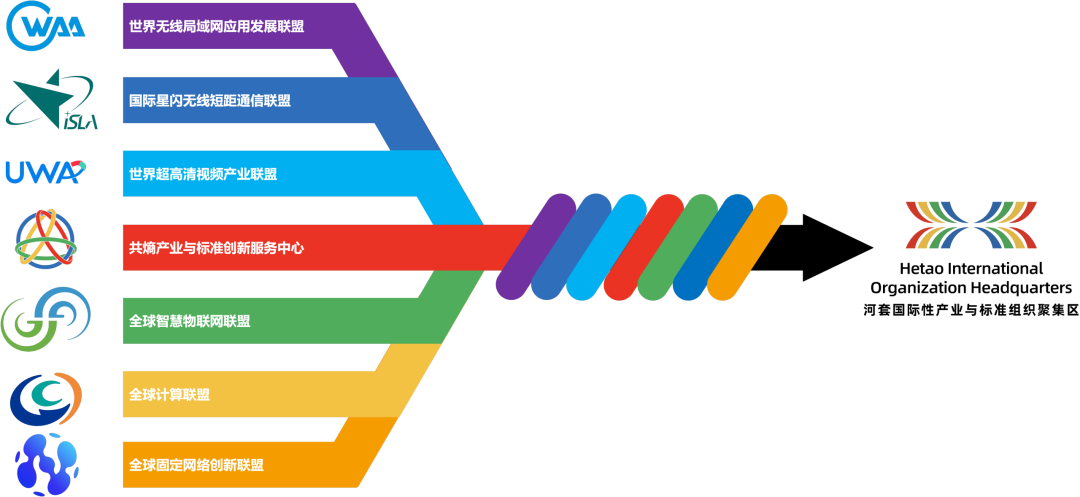 The Hetao International Industrial and Standards Organizations Hub (HIOH) is an international cluster for industrial and standards organizations established in the Shenzhen Park of the Hetao Shenzhen-Hong Kong Science and Technology Innovation Cooperation Zone, adjacent to Hong Kong. The hub has currently gathered international organizations and their service agencies, including the World Wireless LAN Application Development Alliance (WAA), the International SparkLink Wireless Short-Range Communication Alliance (iSLA), the World Ultra HD Video Industry Alliance (UWA), the Global Computing Alliance (GCC), the Global Intelligent IoT Alliance (GIIC), the Network Innovation and Development Alliance (NIDA), and the Comentropy Industry and Standards Innovation Service Center (Comentropy).The emergence of the Hetao International Organizations Hub represents an institutional innovation formed precisely at the intersection of high-level opening-up and technological self-reliance and self-strengthening. It is not a physical aggregation purely driven by policy, but an attempt to use the "small entry point" of international industrial and standards organizations to leverage the "grand landscape" of standard discourse power, industrial ecosystems, and global innovation networks amidst the reshaping of the global technology governance framework.More precisely, the Hetao "1+6" resembles a set of key technical standards organizations growing in synergy: they respectively target wireless LAN application experience, SparkLink short-range communications, ultra-high-definition video, fixed networks, computing architecture and computing power infrastructure, and the Internet of Things (IoT) alongside the HarmonyOS ecosystem. None of these directions represents a single application or a standalone technology; rather, each is a complex system co-constituted by underlying protocols, core standards, testing and certification, product adaptation, scenario verification, and industrial ecosystems. The common question running through these systems is how standards can move from paper into industry, from domestic domains onto the international stage, and from expert consensus into market order.The story of the Hetao "1+6" begins exactly here.
02 Why Hetao: From "Pioneering Demonstration" to "Standard Guidance"
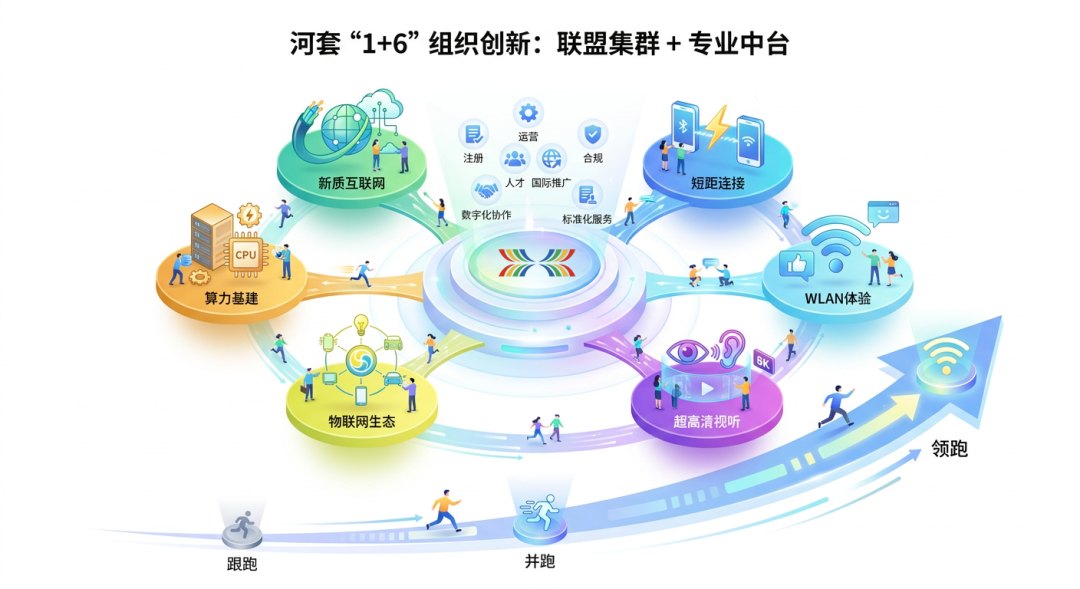
When discussing standards in the past, many people would think of thick documents, marathon meetings, and convoluted clauses. However, in today's industrial competition, standards are no longer just about "writing rules"; they determine whether technologies can interoperate, whether products can be certified, whether scenarios can be replicated, and whether ecosystems can expand. In a sense, standards are rules, and standards are also industrial power.It is by no means accidental that Hetao has become the host ground for this innovation in standards organizations. Its direct policy origin can be traced back to the "40 Items" of the Shenzhen Comprehensive Reform Pilot in 2020. Among them, Item 15 proposed to "innovate the management system of international industrial and standards organizations," providing top-level authorization to break through traditional social organization management models and attract global innovation resources. By August 2023, the State Council issued the *Development Plan for the Shenzhen Park of the Hetao Shenzhen-Hong Kong Science and Technology Innovation Cooperation Zone*, further positioning the Shenzhen Park as an "Experimental Zone for International Advanced Science and Technology Innovation Rules," supporting the deepening of international exchanges and cooperation, attracting top global talents, and promoting the sharing of scientific and technological resources as well as technical standards cooperation.In other words, from the very beginning, Hetao was not just about "building spaces," but was experimenting with a new set of rules: how to make international industrial and standards organizations easier to initiate, more efficient to operate, and more open to absorbing global members, while simultaneously achieving the balance of being "vibrant yet well-regulated" under a comprehensive supervision mechanism.Against this backdrop, in January 2024, the Hetao International Industrial and Standards Organizations Hub was officially unveiled, and the "1+6" ecosystem quickly took shape: one Comentropy Industry and Standards Innovation Service Center, plus six highly focused international alliances.The special feature of the Hetao Hub lies in the fact that it does not merely gather a number of trade associations or industrial alliances, but allows international organizations across different technological directions to form a mutually echoing structure within the same region:- iSLA addresses short-range, highly reliable connectivity;
- WAA addresses the WLAN application experience;
- UWA addresses the ultra-high-definition audio-visual experience;
- NIDA addresses fixed networks and the New Quality Internet;
- GCC addresses computing and computing power infrastructure;
- GIIC addresses the Internet of Things and the HarmonyOS ecosystem;
The Comentropy Service Center serves as the "service middleware," supporting registration, operations, compliance, talent, international promotion, digital collaboration, and standardization services.This is the meaning of "1+6": one standards organization service and aggregation platform supporting the joint growth of six key industrial tracks.These alliances do not exist in isolation; rather, they serve as organizational vehicles for China's transition from "following" to "running alongside, and even leading" in key frontier fields such as post-5G/6G, wireless short-range communications, ultra-high-definition video, the Internet of Things, computing architectures, and fixed networks. They are highly segmented and specialized, yet they share a batch of common requirements: registration, operations, compliance, membership management, international communication, meeting voting, testing and certification, and talent services. The value of Comentropy lies precisely in processing these common requirements centrally, allowing each alliance to focus more intensely on its own core technologies and industrial ecosystem.Therefore, the essence of the Hetao "1+6" is not "putting six organizations together," but an organizational innovation of an "alliance cluster + professional middleware." Each alliance delves deeply into a key track, while Comentropy centrally provides infrastructure-style services, ultimately forming a synergistic effect among standard formulation, product certification, membership networks, international promotion, and industrial deployment.They seemingly belong to different fields, yet they are actually answering the same proposition of the era: as the digital world grows increasingly complex, industrial synergy cannot rely solely on enterprises fighting single-handedly; there must be standards organizations to provide a common language, common interfaces, and common verification mechanisms.03 From "Six Alliances" to "One Ecosystem": The Underlying Logic of Hetao
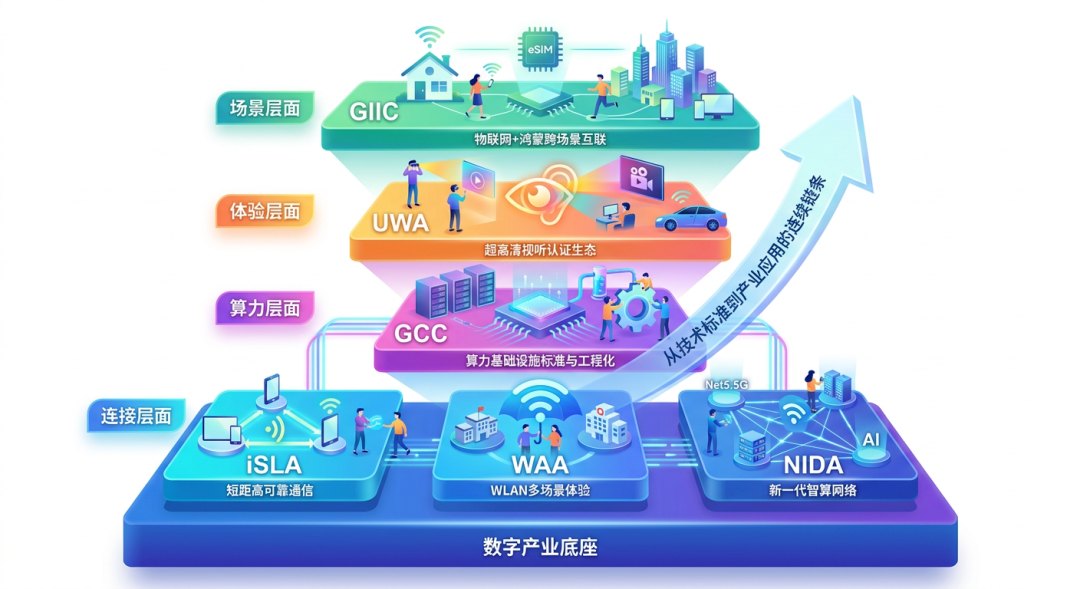
If one looks at the six alliances together, they will find that they are not six isolated lines, but jointly constitute the foundation of the digital industry.At the connectivity level, iSLA focuses on short-range, highly reliable, and low-latency communication between devices; WAA focuses on the quality of the WLAN application experience across campuses, healthcare, small and medium enterprises, and cities; and NIDA pushes the horizon forward into Net5.5G, autonomous networks, intelligent computing center networks, and AI campus network construction.At the computing power level, GCC focuses on infrastructural issues such as BIOS, liquid cooling, AIDC, confidential computing, and Open AI Infra, answering how computing power in the AI era can be standardized, engineered, and globally collaborated upon.At the experience level, UWA ensures that HDR Vivid and Audio Vivid are no longer just technical terms, but enter terminal certification, television broadcasting, cinemas, automotive systems, live tournament broadcasting, and professional production toolchains.At the scenario level, GIIC takes "IoT + HarmonyOS" as the entry point, organizing smart homes, eSIM, pioneer cities, industry standards, and core corporate members to attempt a solution to the long-standing conundrum of interconnectivity across brands, terminals, and scenarios.Therefore, the key to the Hetao "1+6" lies not in the "quantity," but in the "structure": it places connectivity, networking, computing, content, IoT, and standards services into the same organizational ecosystem, forming a continuous chain from technical standards to industrial applications.04 The True Change: Standard Deliverables Have Transformed
In the past, the primary output of a standard was text. Today, the Hetao "1+6" is advancing standards into more executable, verifiable, and reusable industrial capabilities: some manifest as certification credentials and testing platforms, some as engineering specifications and toolchains, and others as operating system ecosystems, scenario-based solutions, and international co-construction mechanisms:- iSLA pushes SparkLink standards into OpenLab, interoperability testing, certification credentials, development kits, and supply chain scenarios such as audio and automotive;
- WAA pushes WLAN application experience standards into performance tiering, testing platforms, scenario credentials, and network acceptance methodologies;
- UWA pushes HDR Vivid and Audio Vivid into terminal certification, cinema signage, channel landing, automotive adaptation, and the Pro Tools professional production toolchain;
- NIDA transforms fixed network innovation into requirements for intelligent computing data center network construction, methodologies for AI campus network construction, adoption of autonomous network tiering, standards led by overseas members, and a replicable network construction standard system;
- GCC pushes computing infrastructure standards into code repositories, demos, interface specifications, rack specifications, cost accounting models, and the Open AI Infra open community;
- GIIC constructs an organizational pipeline around "IoT + HarmonyOS" for cross-brand device interconnection, HarmonyOS ecosystem adaptation, eSIM IoT connectivity, smart home scenarios, pioneer city models, and industry solutions.
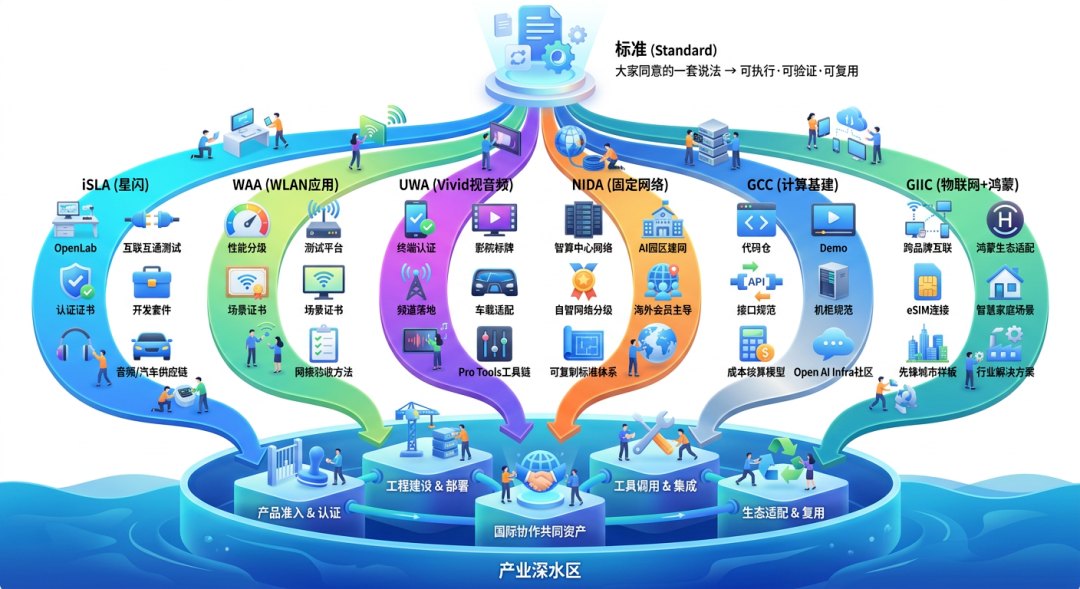 This means that standards are no longer merely "a set of statements agreed upon by everyone," but are further translated into shared assets for product entry, engineering construction, tool calling, ecosystem adaptation, scenario deployment, and international collaboration. Only when standards can be tested, certified, deployed, procured, integrated, and reused do they truly enter the deep-water zone of the industry.
05 Internationalization Is Not "Going Global," But "Joint Formulation"
Another vital transformation of the Hetao "1+6" is the upgrading of its mode of internationalization.In the past, the internationalization of many standards was easily understood as "translating domestic standards into English and bringing them overseas for publication." However, truly vital internationalization is not a unidirectional export, but joint formulation, joint verification, and joint adoption.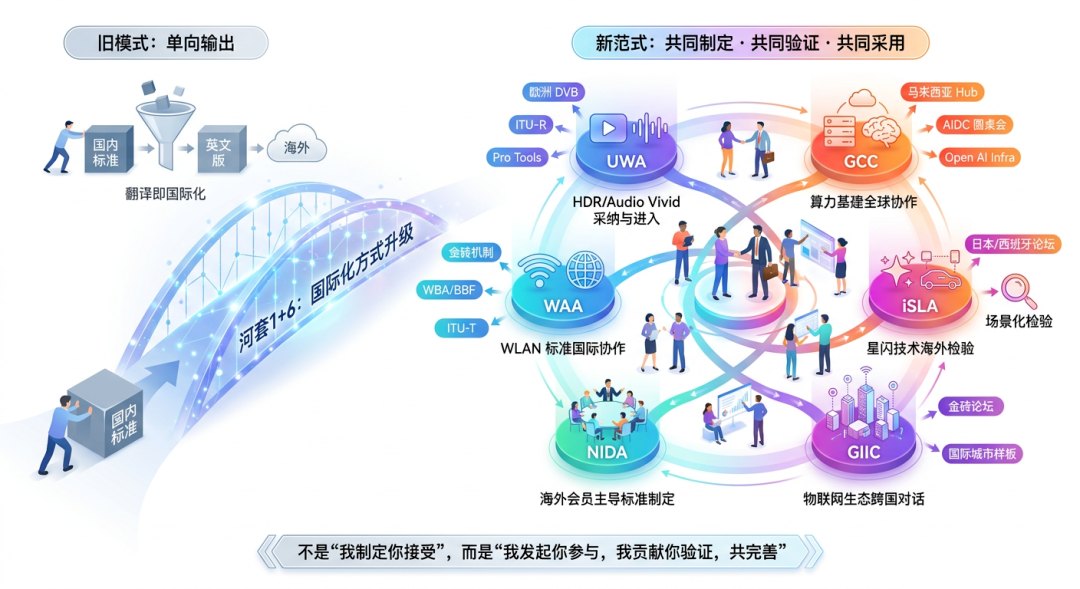 UWA's HDR Vivid has been officially adopted by the European DVB and has entered the ITU-R PDNR; Audio Vivid has entered the Pro Tools professional production toolchain. WAA has opened up an international collaboration channel for WLAN application experience standards through the BRICS new connectivity mechanism, WBA/BBF synergy, and ITU-T docking. NIDA launched its first standard led by an overseas member, meaning that international members are no longer just observers, but have begun to become standard formulators. GCC explores global collaboration for computing power infrastructure through the Malaysia Joint Hub, the AIDC International Roundtable, and the Open AI Infra community. iSLA exposes SparkLink technology to the scenario-based scrutiny of overseas industrial partners through the Tokyo Forum in Japan, the European Forum in Spain, and commercial product showcases. GIIC, through the BRICS New Connectivity Forum, pioneer cities, and international city models, places the IoT ecosystem into cross-border scenario dialogues.Behind this lies a new paradigm: not "I formulate, you accept," but "I initiate, you participate; I contribute, you verify; I form solutions, you jointly refine."
06 Five Hard Metrics of the Hetao Model
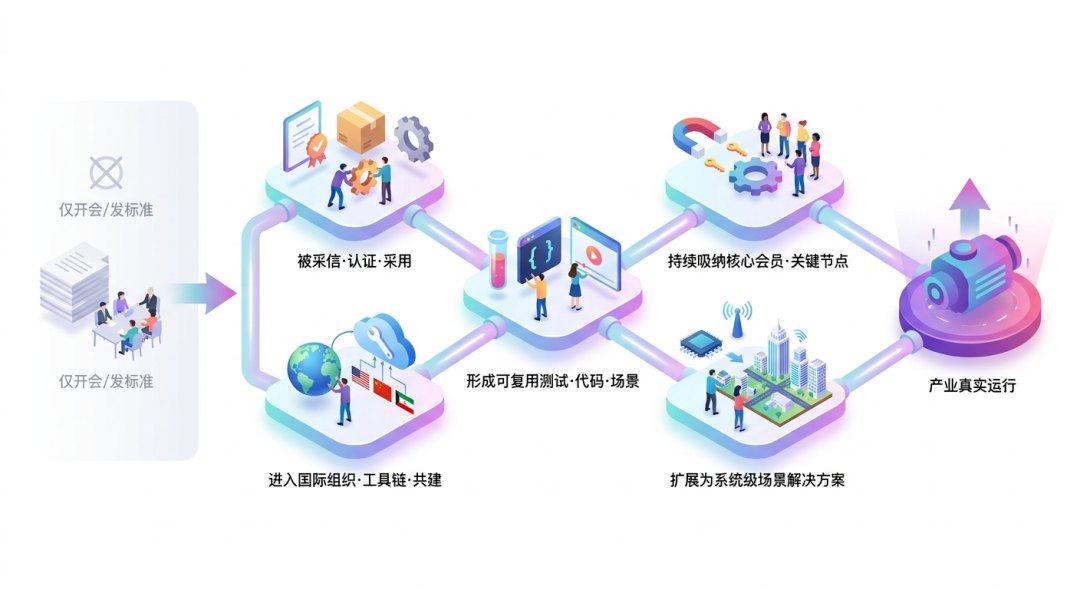
Evaluating the Hetao "1+6" in the future should not merely look at "how many more meetings were held or how many more standards were released," but should look at five harder metrics:- Whether standards are adopted, certified, and utilized by products;
- Whether standards enter international organizations, international toolchains, or the co-construction workflows of overseas members;
- Whether standards form reusable tests, demos, code, certificates, or experience scenarios;
- Whether alliances continuously absorb core members and critical industrial nodes;
- Whether standards expand from standalone technologies into system-level scenario solutions.
These five metrics determine whether a standards organization remains on paper or enters the real operations of the industry.07 Conclusion: What Hetao Truly Produces Is "Synergistic Capability"
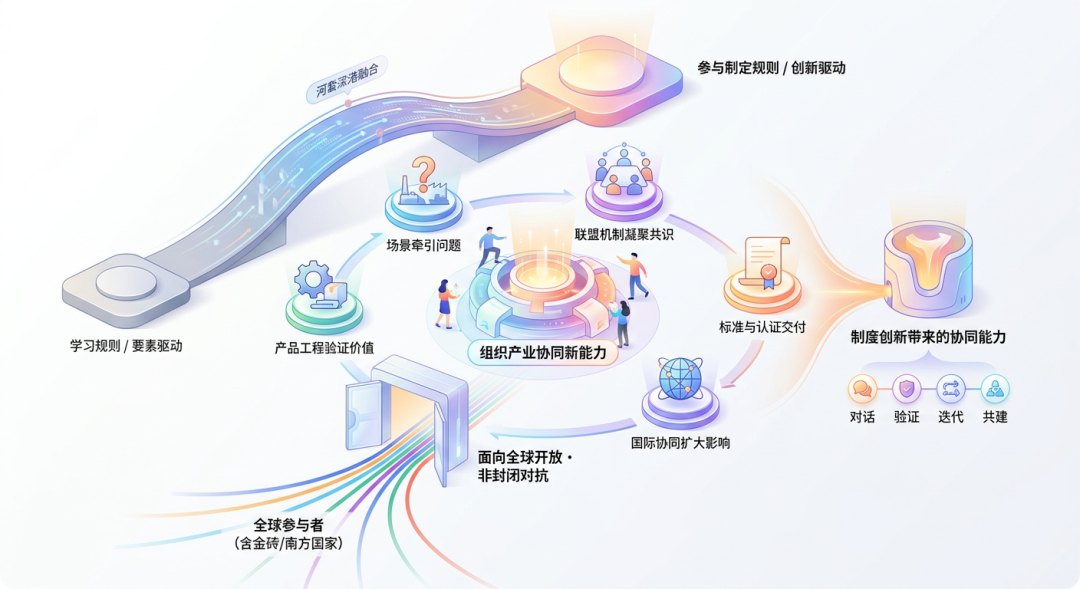
The true variable of the Hetao "1+6" is not any single alliance, a specific technology, or a particular meeting, but a new capability to organize industrial synergy.It is proving that the internationalization of group standards does not have to rely solely on conceptual dissemination, nor does it have to rely purely on single-point technological breakthroughs; rather, it can raise questions through industrial scenarios, condense consensus through alliance mechanisms, complete deliverables through standards and certifications, expand influence through international synergy, and verify value through products and engineering.From a broader coordinate, the birth of the Hetao International Organizations Hub is a miniature of the transition from "learning rules" to "participating in rule formulation," and from "factor-driven" to "innovation-driven" development. Based upon the pioneering demonstration of Shenzhen, relying on Shenzhen-Hong Kong integration, and facing global openness, it connects technological governance, industrial standards, and innovation ecosystems using international organizations in specific domains as an entry point.Nor is it a closed, adversarial "starting anew"; rather, it is an open competition and international co-construction: leveraging China's market scale, technological accumulation, and ecological vitality to attract global participants to jointly formulate standards that are more usable, more verifiable, and more deployable. For BRICS nations and the Global South, these organizations may also provide more technological choices, cooperation mechanisms, and entry points for industrial participation.Therefore, what Hetao truly produces is not just standard texts, nor is it merely certification credentials, but the synergistic capability brought about by institutional innovation: allowing different enterprises, different countries, and different technological routes to converse, verify, iterate, and co-build within the same framework of issues.This is the significance of the Hetao "1+6": it is not a simple assembly of six organizations, but an exploration into a new, replicable paradigm of standards organizations.If technological innovation determines how fast an industry can walk, then standards organizations determine how far the industry can travel. The Hetao International Industrial and Standards Organizations Hub is precisely attempting to pave this road.