
Focusing on Scenario Requirements and Technical Challenges of 100Mbps Single Pair Ethernet: The Second Event of the Zhiyao Salon "Interconnecting All Industries" Series Held Online
Single Pair Ethernet (SPE) breaks through traditional Ethernet limitations of "four pairs/eight cores with a maximum length of 100 meters," enabling data communication and Data Line Power (PoDL) over just a single twisted pair. In June 2026, IEEE 802.3dg-2026 was officially published, boosting single-pair speeds to 100 Mbps and extending transmission distances up to 500 meters. This forms a complementary capability matrix with Ethernet-APL's intrinsically safe low-speed route (10 Mbps, 1,000 meters)—establishing a dual paradigm of "intrinsically safe low-speed" and "non-intrinsically safe high-speed"—and ushering in a new era for 100Mbps long-reach Single Pair Ethernet.
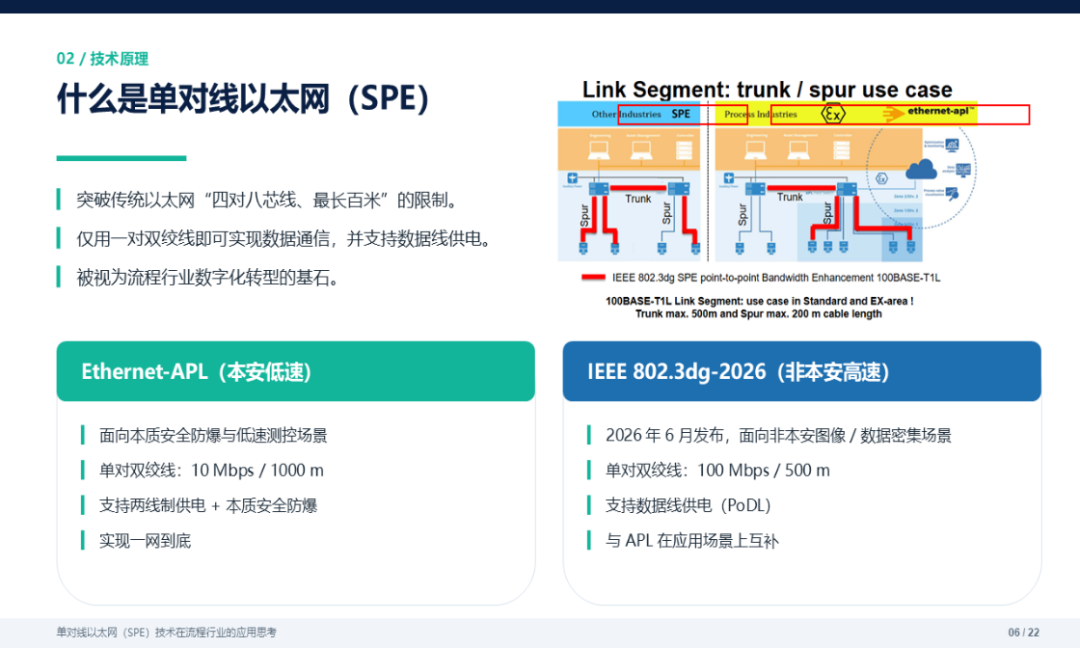
Figure 1 Dual Technical Routes of Single Pair Ethernet: Ethernet-APL Intrinsically Safe Low-Speed vs. IEEE 802.3dg-2026 Non-Intrinsically Safe High-Speed (Source: Hu Yongkang's Presentation)
In his presentation titled Reflections on the Application of Single Pair Ethernet (SPE) Technology in Process Industries, Hu Yongkang pointed out that process industries have long relied on 4-20mA analog signals and low-speed fieldbuses with typical speeds of just 31.25 kbps. Existing technologies struggle to simultaneously satisfy the twin demands of "long distance + high bandwidth," making SPE widely recognized as the cornerstone for digital transformation in process industries. He introduced five benchmark application scenarios: remote real-time monitoring and dispatch of smart instruments, machine vision process status monitoring, multi-node data aggregation for remote I/O, integrated video and control in high-risk zones, and predictive maintenance & remote O&M. Citing market data showing that industrial Ethernet accounts for 79% of the market with a 12% annual growth rate, he noted that SPE—carrying all protocols over a single pair—is poised to drive the physical layer of industrial Ethernet toward unification. He stated that China has established a comprehensive layout covering chips, instruments, switches, DCS, and application deployment, with policy guidance and ecosystem synergy advancing together; however, a gap remains with leading international vendors in the 100 Mbps direction.
Chen Dongfei shared Ethernet transmission practices for edge intelligent visual instruments tailored for fine chemical scenarios. He highlighted three long-standing pain points in chemical processes—such as extraction stratification, reaction kettle status monitoring, and pipeline blockage detection—which have relied heavily on manual visual inspection, resulting in strong subjectivity, delayed response, and personnel exposure in high-risk environments. Meanwhile, traditional architectures combining "explosion-proof cameras + centralized server analysis" face three dilemmas: insufficient real-time capability, a trade-off between cost and efficiency, and concentrated reliability risks. Edge intelligent visual instruments execute image acquisition, spectral analysis, and AI recognition locally with a response time under 200 milliseconds, leaving the network to carry only detection results and real-time video streams. He emphasized that "10M being enough is an illusion": as resolutions scale to 4MP and 8MP alongside parallel data streams, 10 Mbps bandwidth quickly becomes a bottleneck. Long-reach 100Mbps Single Pair Ethernet—combining 100Mbps bandwidth with long-distance power supply—serves as the true long-term infrastructure for visual instrument data value.
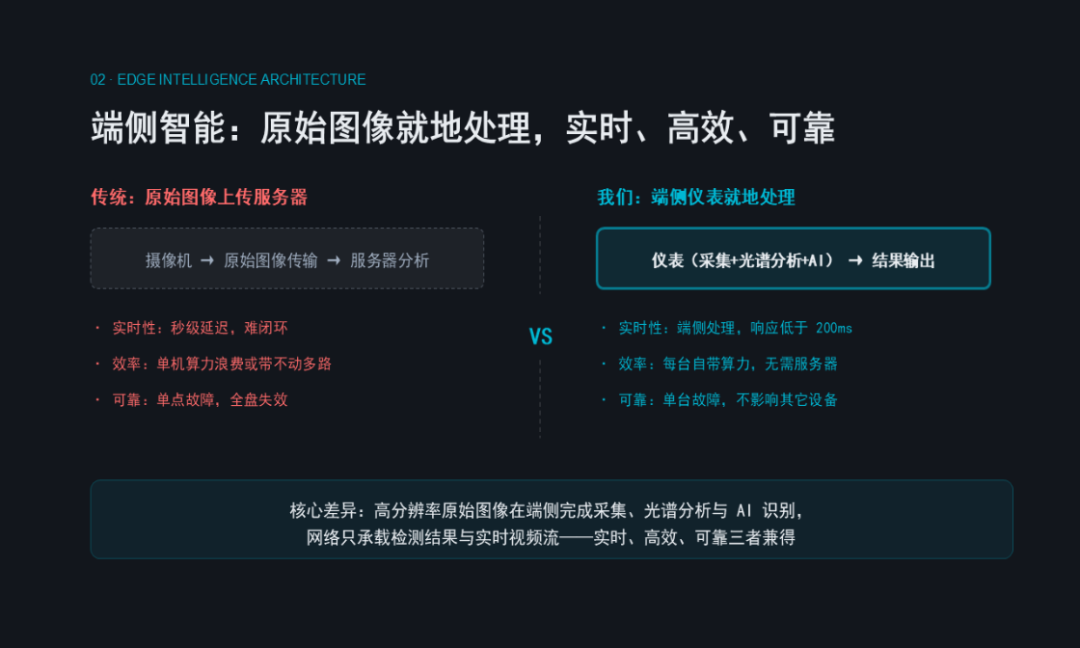
Figure 2 Comparison between Edge Intelligent Visual Instruments and Traditional Centralized Processing Architectures (Source: Chen Dongfei's Presentation)
Tan Yuxuan systematically outlined the standards and application landscape of automotive 100Mbps Single Pair Ethernet. She explained that IEEE 802.3bw (100BASE-T1) relies on key physical layer technologies such as hybrid/echo cancellation and MASTER-SLAVE modes to satisfy stringent automotive EMC requirements while achieving harness weight reduction and cost control, delivering high-speed data transmission over a single pair of twisted wires. Nationally, the recommended automotive industry standard Technical Requirements and Test Methods for Automotive Ethernet 100Mbps Physical Layer Interface (PHY) Chips (QC/T 1286—2026) was released on June 1, 2026, and will be implemented on December 1, 2026, marking China's first industry standard specifically tailored for automotive single-pair 100Mbps PHY chips. Furthermore, the national standard series Road Vehicles — Automotive Ethernet (identically adopting ISO 21111) is currently in the approval pipeline, signaling the rapid maturation of China's automotive SPE standard system.
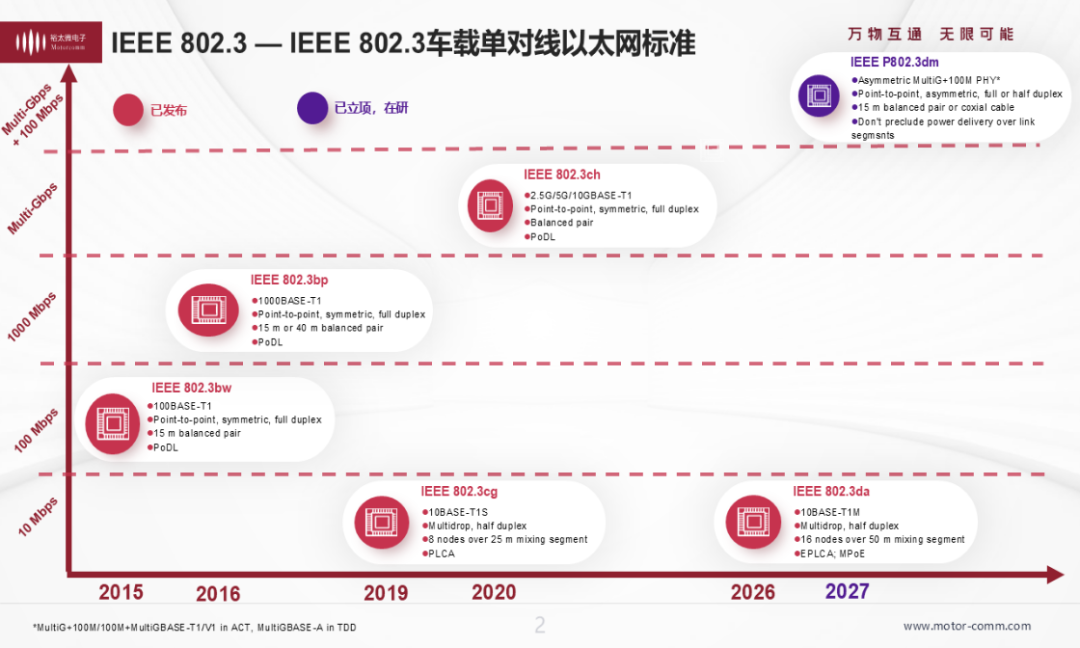
Figure 3 Evolution of IEEE 802.3 Automotive Single Pair Ethernet Standards (Source: Tan Yuxuan's Presentation)
During the open discussion, attending members exchanged deep insights on scenario requirements, power delivery capabilities, intrinsic safety compatibility, and chip industrialization for 100Mbps Single Pair Ethernet. The salon reached a clear consensus: the release of the 100BASE-T1L standard fills the gap between the two existing routes of "10M long-reach" and "100M short-reach," addressing a clear and urgent demand for long-reach 100Mbps SPE in process industries and fine chemicals. NIDA will continue organizing technical salons to gather industrial strength, promote ecosystem deployment, and accelerate standards formulation.